Colour Mixing for Everyday Practice
Colour Mixing for Everyday Practice
Colour is one of the most immediate and surprising parts of making. A practical approach focuses on predictable results rather than chasing every possible hue. The right habits and a compact palette make mixing more reliable and less wasteful.
Start with a small, trustworthy palette
Choose a basic set of pigments that cover warm and cool versions of primary colours, plus a neutral dark and a warm or cool white if you use it. For many users, a quartet of four or five tubes simplifies decisions and produces a broad range of mixes. Fewer colours reduce the chance of muddiness and make color relationships easier to predict.
Understand relative mixing
Instead of aiming to copy a target colour exactly, learn to mix relatively: identify whether the target is warmer or cooler, lighter or darker, and then adjust your base mix accordingly. Mixing in small increments and making test swatches helps you see the direction of change. Keep the initial ratios simple: stronger mid-tones with small tints of the third colour for adjustment.
Make controlled swatches
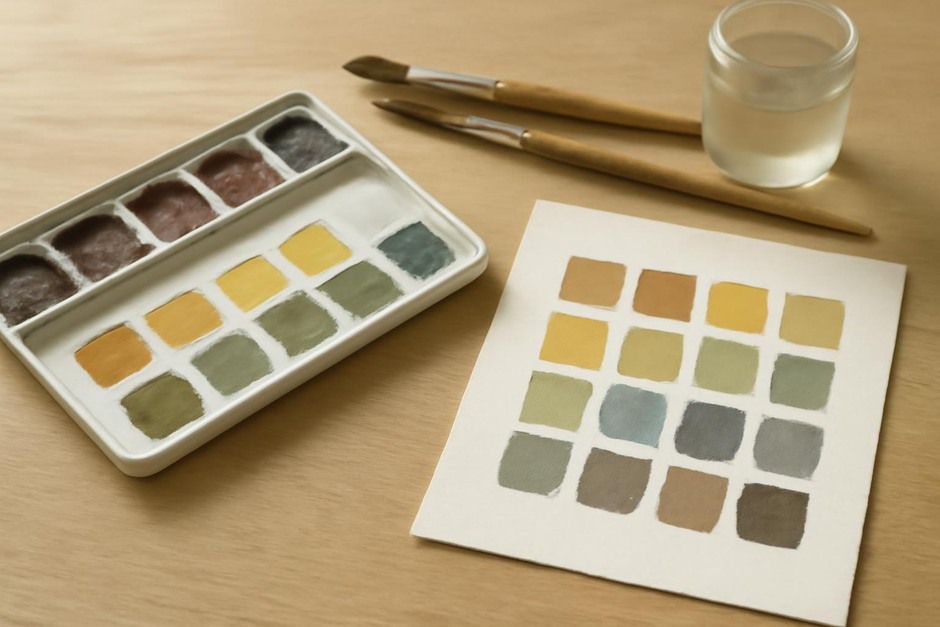
Create a habit of making small swatches beside a study. Apply the mixed colour flatly and let it dry for an honest read. Label each swatch with pigment notes and rough ratios. Over time these swatch records become a personal reference library for achieving consistent hues.
Use neutral greys and earths intentionally
Neutral greys and earth pigments are useful for tempering saturation and creating believable shadow. Adding a touch of a neutral rather than more of a complementary colour often preserves the mix’s character while reducing vibrancy. Earth tones also help tie bright colours into a unified atmosphere.
Control value first, then chroma
Value, or lightness, is the main contributor to legibility in an image. When mixing, first get the value relationship close to the target; once values read correctly, adjust chroma and hue. Working value-first keeps compositions coherent even with imperfect colour matches.
Limit white for harmony
Small additions of white can quickly change temperature and saturation. Use it with restraint if you want to maintain harmony, or employ a toned ground to reduce reliance on heavy white. A neutral or warm ground influences the perceived temperature of colours applied over it.
Practice small, repeatable recipes
Develop short, repeatable mixing recipes for common needs: a skin tone family, a set of shadow greys, or foliage ranges. Recording proportions in a few words or numbers makes reproducing a successful mix easier, especially when returning to work after a break.
Colour mixing becomes a practical skill through repetition, careful records, and a compact palette. With modest constraints and regular swatching, you’ll find predictable ways to achieve moods and relationships in your work without excessive trial and error.