Composition Foundations: Arranging Visual Ideas
Composition Foundations: Arranging Visual Ideas
Composition is less about formal rules and more about purposeful choices that direct the viewer’s attention. Clear structure, repeated testing, and modest constraints help you compose with intention whether you work small in a sketchbook or on larger surfaces.
Start with thumbnails
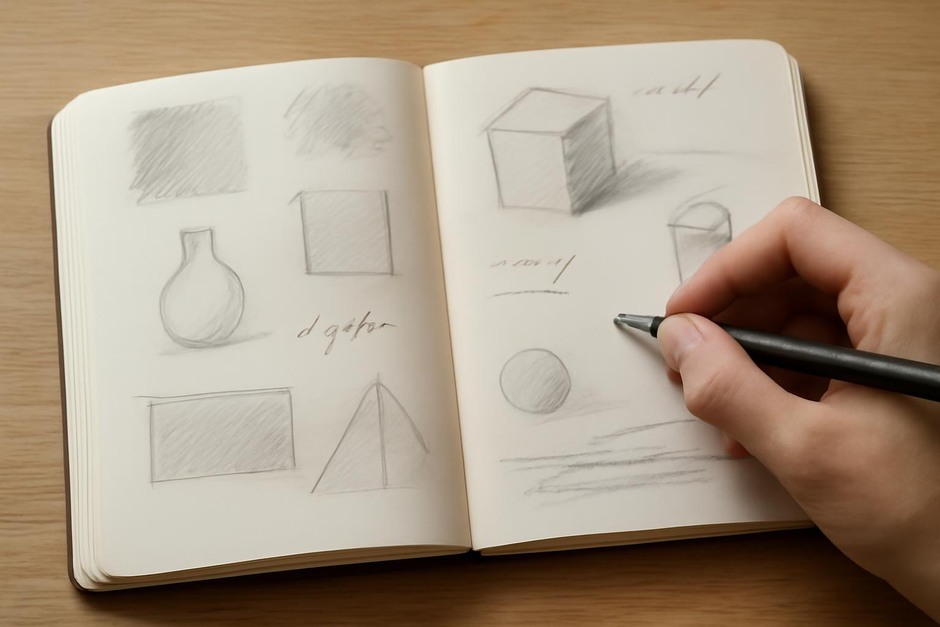
Thumbnails are small, fast sketches that let you explore arrangements without commitment. Work at a scale where you can sketch several ideas on a single page. Limit each thumbnail to basic shapes and tonal values to quickly compare overall balance and hierarchy.
Use simple frameworks
Frameworks such as thirds, diagonals, or a central axis offer starting points for balance. A grid can help place major elements consistently across variations. These frameworks are tools, not rules: use them to test relationships and find a direction rather than to constrain expression.
Establish a clear focal point
Decide what should be most important in the composition, then organize other elements to support it. Contrast, isolation, directionality, and line weight help create emphasis. Reducing detail or simplifying surrounding areas can also sharpen focus without adding more elements.
Consider rhythm and repetition
Repeated shapes, motifs, or directional marks create rhythm and guide the eye. Vary the scale or spacing of repeated elements to avoid monotony while maintaining visual coherence. Rhythm helps move attention through a composition smoothly.
Test value relationships early
Value is one of the fastest ways to communicate structure. Block in darks, midtones, and lights in a preliminary pass to see whether the overall design reads clearly. A successful value plan often remains effective even when colour changes later in the process.
Iterate with small interventions
Rather than redraw from scratch, try minor adjustments: shift a shape slightly, crop the composition, or change the size of a single element. Iteration reveals which small changes significantly improve clarity and which do not.
Leave breathing room
Negative space is not empty; it shapes the composition and can become an active element. Allow margins and quiet areas to balance denser regions. Often, a stronger composition emerges when there is intentional restraint.
Composition is an economical problem-solving practice. By using thumbnails, simple frameworks, and iterative testing focused on value and emphasis, you can arrange visual ideas with clarity and purpose. The techniques are portable: they work in sketchbooks, quick studies, and larger compositions alike.